
At my housewarming party a few weeks ago, 50 of my friends were coming and going throughout the day. A table stood heaped with all of that complicated food we make for special occasions and flowers, little origami houses were strung across the dining room, my children used “company manners” and my shy husband was handing out beer. Towards the end of the party we there was a cake send-off for our exchange student, heading back to Sweden.

Alone in the kitchen late in the day my mother, who had said not a word to me thus far, kind or otherwise, asked me, “Should we open presents now?”
“Mine or Sven’s?” I asked, because, although guests had been forbidden to bring presents some had, and presents were piling up in the entryway. And the boy’s name isn’t Sven but his real name doesn’t sound Swedish.
“Why would anyone bring you presents?” she snarled.
And this is precisely how, on a glorious day full of love and good cheer, in a new home awash in flowers, your Narcissist Mother manages to eviscerate you, standing there in your new outfit, basking in the warmth of all your friends. This is how a Narcissistic Mother takes you down a notch on a beautiful day.
I am not a therapist, and my own ability to behave like a functioning adult surprises me at the end of each and every day. Even just there I exaggerated, because I do not always function well. This post will not be about healing. Healing from a cruel mother is a long, individual and complicated process.
If my mother’s behavior sounds eerily familiar, here is list of the 21 Signs of a Narcissistic Mother by Alexander Bergemeester.
My mother is a master of every item on the list, but only managed to execute about half the list the day of the party. The next day, when I confronted her about the comment in the kitchen, she gaslighted me, did a #6, followed by #7— verbatim—with #14 via text as a grand finale.
For almost 18 years, being a wife and mother has been my obsession and my sole vocation. A few days after the birth of my first child, post-partum depression quite swiftly disillusioned me of any confidence I would parent well. I have since carried a lot of self doubt. For me, parenting has been like teaching Japanese without knowing a word of the language.
My mothering is self-taught; it has been a combination of Joan Cleaver’s clean kitchen and regular meals weaved with a frenetic, angst-ridden perfectionism and lots of necessary apologizing. For eighteen years I have cooked and cleaned kept the house full of books and taught my children that all we have is a gift from God to be shared with whomever needs it. This is all I have known how to do.
My children are teenagers and have survived thus far. The question becomes, when they are no longer under the same roof, when I cannot offer them bandaids and wash their clothes and cook their meals and fill an ice pack for a twisted ankle, how do I love them? How do I not leave them standing bereft in a kitchen on a happy day?
Allow me to introduce you to some beautiful women.

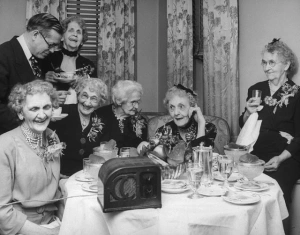
My little, Portuguese, polyglot friend, 80 years old, has patiently tried to teach me to knit over and over for 30 years, and still encourages me despite my utter inability to do it. When she visited the States this spring, she spent every free minute she had knitting a throw blanket for the sofa in my new house, in a color I love.
The retired CIA agent at the housewarming, when she met my mother, told her all sorts of nice things about me. She kept affirming my goodness saying her who-knows-what, despite my mother staring at her unresponsive and blank.
Swedish Katarina, Sven’s mother, spent the entire housewarming party washing china because I am too snobby for paper plates and because she wanted me to have time with my friends.
Years ago, a Catholic friend with ten kids made the time to drive thirty minutes when I was in a deep depression, bringing Vitamin B drinks and making dinner for my children.
My tennis pro, who asked after a lesson if I had dinner planned for the kids, and when I said I did not, ran to her fridge and grabbed a tray of steaks for absolutely no reason whatsoever. When I unexpectedly did not show up for a group lesson, she stopped the lesson and gathered all the ladies to pray for me.
A retired couple from church offered to stay with the kids for a weekend in October so my husband and I, who have very little time together, can go on a retreat. (Yes, my teens do find this awkward. They would like you to know they are too old for this.)
My Austrian friend massages my neck when I cannot sit up straight and gives me green smoothies that are actually okay.
My mother-in-law never forgets an occasion, and always sends a card.

My little, ancient, Russian auntie taught me to fan short pieces of bacon like sun rays and fry an egg in the middle, and once scolded me when I spoke harshly to my children, saying it was just as easy to be kind.
The kindness of women is both hospital and school. Kind women teach a common-sense love born of affirmation, meals, prayers and patience, the wisdom of gentle correction and the ability to notice a need and fill it. For those of us without this frame of reference, these lessons are apples of gold in settings of silver.
I leave you with this poem about kindness. The title throws me; I prefer to think of it as What I Learned From Good Women.
What I Learned From My Mother by Julia Kasdorf
I learned from my mother how to love
the living, to have plenty of vases on hand
in case you have to rush to the hospital
with peonies cut from the lawn, black ants
still stuck to the buds. I learned to save jars
large enough to hold fruit salad for a whole
grieving household, to cube home-canned pears
and peaches, to slice through maroon grape skins
and flick out the sexual seeds with a knife point.
I learned to attend viewings even if I didn’t know
the deceased, to press the moist hands
of the living, to look in their eyes and offer
sympathy, as though I understood loss even then.
I learned that whatever we say means nothing,
what anyone will remember is that we came.
I learned to believe I had the power to ease
awful pains materially like an angel.
Like a doctor, I learned to create
from another’s suffering my own usefulness, and once
you know how to do this, you can never refuse.
To every house you enter, you must offer
healing: a chocolate cake you baked yourself,
the blessing of your voice, your chaste touch.
More than therapy, more than prayer and even more than writing, the kindness of good women helps to heal the wounds a narcissistic mother spends a lifetime inflicting. Find those women and let them work their magic. And when you begin to heal, be the good woman other hurting women need.
 A Word, Please. . .